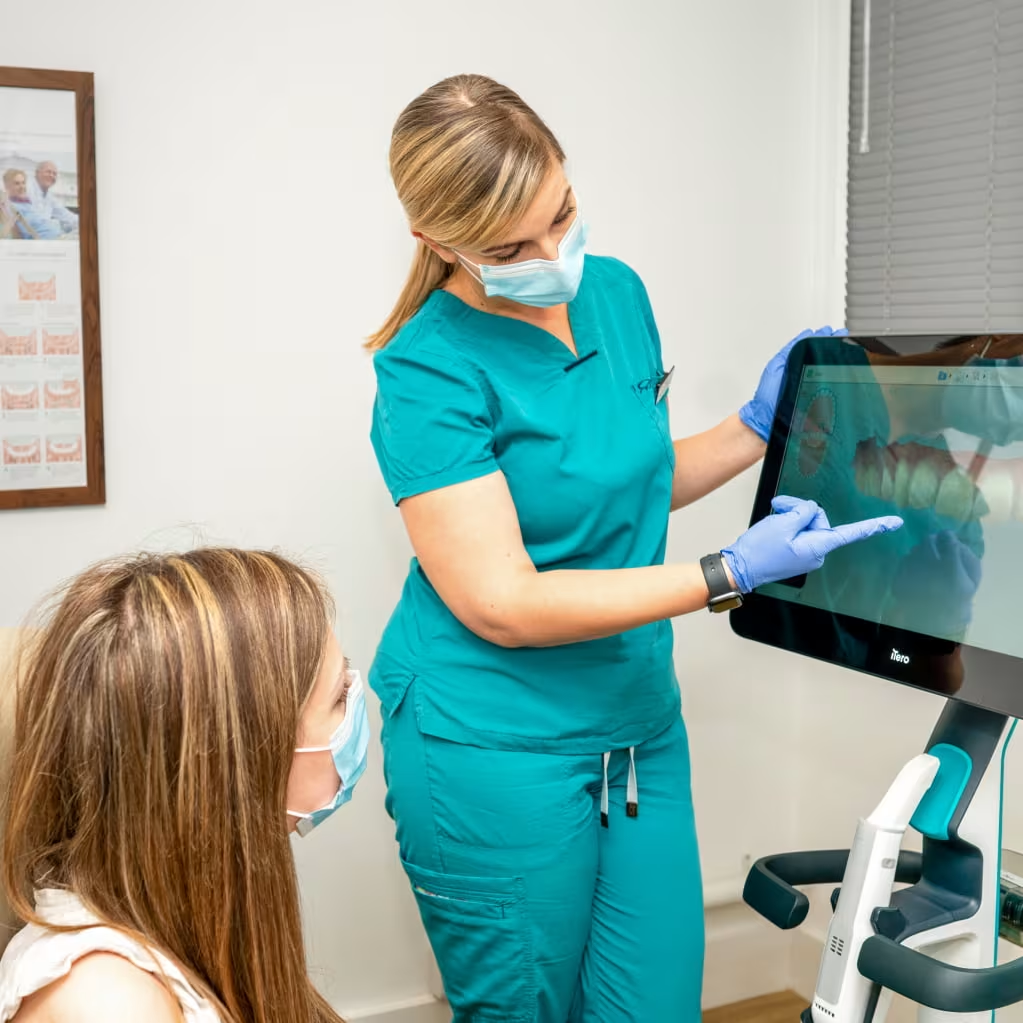
You are sitting in the dental chair and someone is working around your mouth with a probe, calling out numbers to a colleague who is writing them down. Two, three, two. Three, four, three. It does not feel painful – more like a mild pressure – but nobody has fully explained what is happening or what the numbers mean.
This is six-point pocket charting, and it is one of the most informative gum assessments we carry out at The Briars. It tells us more about the health of your gums and the bone supporting your teeth than almost any other single test. Understanding what the numbers mean, and why we take six measurements per tooth rather than one, will help you make sense of your results and what happens next.
This article about pocket charting, has been written with input from Sharmila Khopade, our specialist periodontist at The Briars. Sharmila accepts both internal referrals and self-referrals from patients who have concerns about their gum health – no GP or dentist referral is needed to book a consultation.
Around every tooth, there is a small cuff of gum tissue. In good health, this cuff fits closely against the tooth and the space between the gum edge and where it attaches to the tooth is shallow – typically between one and three millimetres. This space is called the sulcus, or the periodontal pocket.
When gum disease is present, bacteria accumulate below the gum line and trigger an inflammatory response. Over time, this damages the attachment between the gum and the tooth, and the underlying bone. The pocket deepens. The deeper the pocket, the more difficult it is to clean, and the more the disease can progress unchecked.
Pocket charting to record these depths is therefore one of the most reliable indicators of gum disease severity. But a single measurement per tooth would miss a great deal of what is happening.
Each tooth has a complex three-dimensional shape. The pocket depth on the front surface of a tooth can be completely different from the depth on the back surface, or the depth in the narrow space between two adjacent teeth. Disease does not distribute itself evenly – it concentrates in the areas that are hardest to clean, that experience the most stress, or where the anatomy of the tooth root creates a natural trap for bacteria.
Six-point pocket charting records depth at three points on the outer (buccal) surface of each tooth — mesial, mid-point, and distal — and three corresponding points on the inner (palatal or lingual) surface. This gives us a comprehensive map of pocket depth across the entire tooth, not just a snapshot from one angle.
For a full mouth with 28 teeth, this means 168 individual measurements. It takes time and precision to do properly. At The Briars, it is carried out using a calibrated periodontal probe, with millimetre-marked measurements recorded by a second clinician to ensure accuracy.
Six-point pocket charting is the standard recommended by the British Society of Periodontology for comprehensive periodontal assessment. It is the clinical foundation for staging and grading gum disease under the internationally accepted BSP classification system.
The measurements are recorded in millimetres. Here is how to interpret them:
|
Depth |
Status |
What it means |
What typically follows |
|
1-3 mm |
Healthy |
Normal sulcus depth. Gum attachment intact and bone stable. |
Maintenance. Good home care and regular hygiene appointments. |
|
4 mm |
Watch closely |
Early pocket formation. Some attachment loss possible. Bleeding on probing is significant at this depth. |
Improved home care. Hygiene treatment. Close monitoring. |
|
5-6 mm |
Active disease |
Moderate periodontitis. Bone loss likely. Beyond the reach of a standard toothbrush or floss. |
Root surface debridement (RSD). Possible referral to Sharmila for specialist treatment. |
|
7 mm+ |
Significant disease |
Severe periodontitis. Significant bone loss. Tooth stability may be affected. |
Specialist periodontal treatment. Surgical assessment may be required. |
Pocket depth alone does not tell the complete story. Sharmila also records bleeding on probing, recession, furcation involvement (whether disease has reached the point where the tooth roots divide), and tooth mobility. Together, these findings are used to assign a BSP stage and grade to your disease – a standardised system that describes both the severity of damage and the rate at which it is progressing.
When a healthy pocket is probed gently, there is no bleeding. When the pocket is inflamed — because bacteria are present and the tissue is actively responding — probing causes bleeding. This is not caused by the probe being too rough. It is caused by fragile, inflamed blood vessels in the pocket wall.
Bleeding on probing is one of the most reliable signs of active gum disease. When Sharmila or your hygienist records bleeding at a site, it tells us that the disease at that location is not dormant — it is progressing. Multiple bleeding sites are a strong clinical signal that treatment needs to go beyond improved brushing.
Equally, a reduction in bleeding on probing after treatment is one of the most reliable signs that treatment is working. It is one of the key markers Sharmila uses to assess your response to therapy at the reassessment appointment.
What Happens After Charting?
Six-point charting is not a standalone test — it is the starting point for a clinical conversation. Once your full chart is complete, Sharmila will go through the findings with you, explain what the numbers mean in your specific case, and discuss the treatment plan that follows.
If your scores are mostly healthy:
Pocket charting which indicates measurements of one to three millimetres with no bleeding on probing suggest your gum health is in good shape. The focus is on maintaining what you have – good home care technique, regular hygiene appointments, and monitoring over time.
If you have moderate pocketing:
Pockets of four to six millimetres, particularly with bleeding, indicate that professional intervention is needed. Root surface debridement – a thorough cleaning of the tooth root surfaces below the gum line, carried out under local anaesthetic – is typically the first line of treatment. This removes the bacterial deposits that are sustaining the disease and allows the tissue to heal.
After RSD, a reassessment appointment is scheduled — usually eight to twelve weeks later — to remeasure your pockets and assess your response. At The Briars, this reassessment is never skipped. It is how we know whether treatment has worked or whether further intervention is needed.
If you have deep pocketing or significant disease
Pocket charting that shows pockets of seven millimetres or more, significant bone loss, furcation involvement, or tooth mobility require specialist periodontal assessment. This is exactly the level of complexity that Sharmila manages at The Briars. Depending on the findings, treatment may include more intensive root surface debridement, surgical procedures to access and clean deep pockets, or assessment of whether certain teeth can be retained long-term.
We have written in more detail about what the full gum disease treatment process looks like at The Briars, including the stages from assessment through to long-term maintenance.
Gum disease is a chronic condition — it does not resolve permanently. Even after successful treatment, the underlying susceptibility remains. Long-term maintenance, typically every three to four months for treated periodontitis patients, is not optional. It is what prevents the disease from returning.
Active gum disease is a contraindication for both dental implants and aligner treatment. Placing an implant into a mouth with uncontrolled periodontitis significantly increases the risk of peri-implantitis — an infection around the implant that can lead to bone loss and implant failure. Moving teeth with aligners in the presence of active gum disease can accelerate bone loss around the teeth being moved.
If you have been told you need to address your gum health before proceeding with implants or orthodontic treatment, this is the clinical reason why – and it is the correct sequence of treatment, not a delay for its own sake.
You do not need a referral from your own dentist to see Sharmila at The Briars. If you have been told you have gum disease, if you have noticed bleeding when you brush, if your gums have receded, or if you are concerned about your gum health, you can contact us directly to book a periodontal consultation.
At your consultation, Sharmila will carry out full six-point pocket charting, review any existing X-rays or take new ones if needed, and give you a clear picture of where your gum health stands and what your treatment options are.
For further independent information on gum disease, pocket charting and periodontal treatment, the British Society of Periodontology publishes patient resources here.
Back to blog