Dental Check-Up: 6 Surprising Reasons You Need One Now
It’s one of the most common things we hear, and if you’ve thought it yourself, you’re in good company: “I’ll go to the dentist when something actually hurts.” It’s a logical position on the surface – why sit in a dental chair if nothing seems wrong? But it’s a position that, unfortunately, doesn’t reflect how dental disease actually works.
The inconvenient truth about the most serious conditions affecting your teeth, gums, and mouth is that many of them cause no pain at all in their early stages. By the time something hurts, the problem has often been developing quietly for months – or years – and the treatment required is almost always more complex, more involved, and more costly than it would have been had it been caught earlier.
This article isn’t intended to alarm you. It’s intended to give you an honest picture of what a regular dental check-up actually does, why it matters even when everything feels fine, and what your dentist is looking for when you’re in the chair.
Table of Contents
A dental check-up is considerably more than a quick look at your teeth. Your dentist is systematically assessing the health of your entire mouth – teeth, gums, soft tissues, jaw, and bite – as well as screening for conditions that extend beyond dentistry into broader health.
At The Briars, a new patient dental check-up is a thorough appointment that gives your clinician a complete baseline picture of your oral health. For existing patients, your dental check-up builds on that baseline – tracking changes over time, monitoring areas of concern identified at previous visits, and updating your records to reflect your current health and medical history.
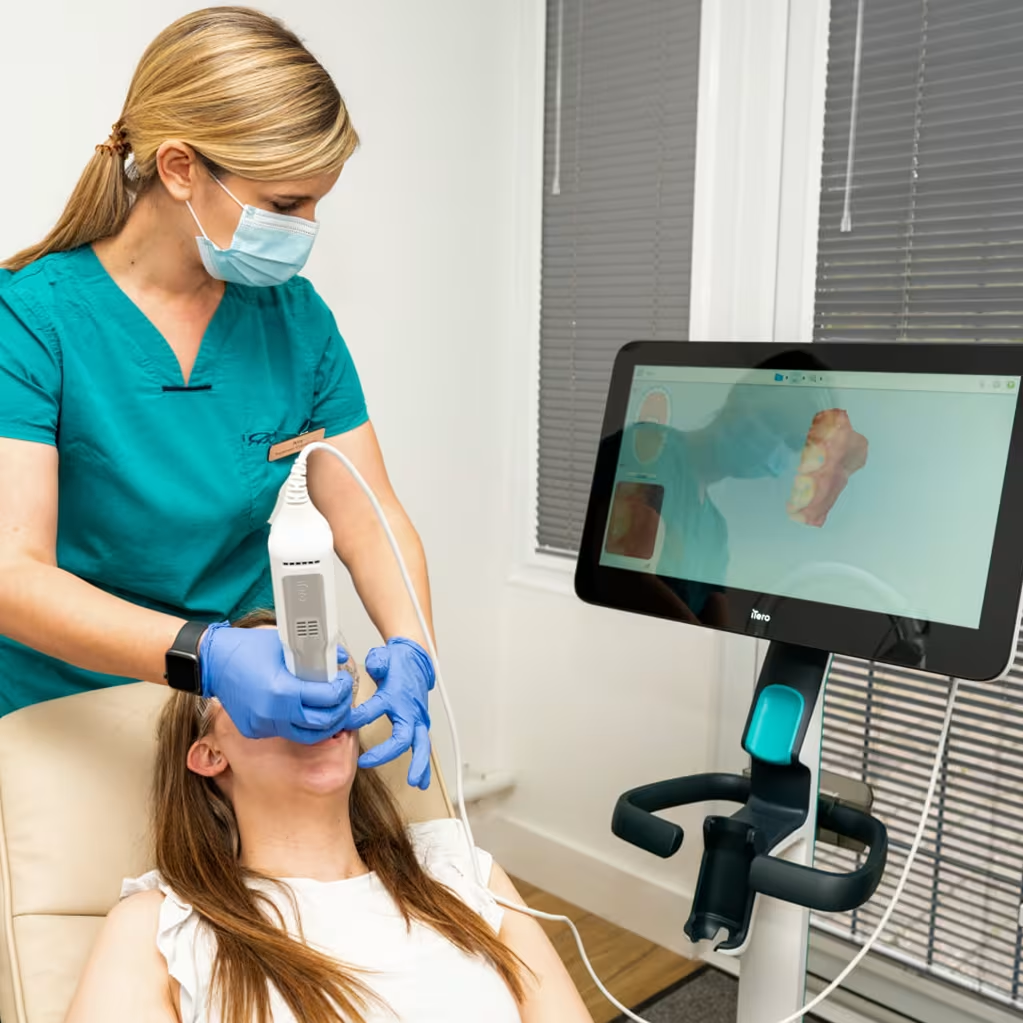
X-rays are taken where clinically indicated, not as a matter of routine for every patient at every visit, but where they provide information that cannot be gathered from a visual examination alone. The spaces between teeth, the bone supporting your teeth, and the areas beneath existing restorations are simply not visible without them – and some of the most significant findings at a dental check-up are made on radiographs rather than through direct inspection.
Tooth decay is probably the condition most people associate with dentistry, and yet it is also one of the most commonly misunderstood in terms of how it feels – or more accurately, how it doesn’t feel – in its early stages.
Decay begins on the outer surface of the tooth, in the enamel, where there are no nerve endings. A cavity forming in enamel causes no pain, no sensitivity, and no outward sign that anything is wrong. It is only when decay progresses through the enamel and into the dentine beneath – or deeper still, towards the pulp of the tooth – that symptoms begin to develop. At that point, a small restoration that could have addressed the problem months earlier may no longer be sufficient.
This is why X-rays matter. Decay between teeth, beneath the contact points where two teeth touch, is invisible to the naked eye and can only be detected radiographically. Patients are frequently surprised to learn that a cavity has been identified at a dental check-up when they had no awareness of it whatsoever – and the appropriate response to that surprise is relief, not scepticism, because catching it early is precisely the outcome a regular dental check-up is designed to achieve.
Gum disease is the leading cause of tooth loss in adults in the UK, and it is estimated that the majority of adults have some degree of gum disease at any given time. It is also, in its early and moderate stages, almost entirely painless.
Gingivitis – the mildest form of gum disease, characterised by inflammation of the gum tissue – causes bleeding on brushing in many patients, but this is so commonly normalised that people assume it is simply what their gums do. It isn’t. Bleeding gums are a sign that something needs attention, and gingivitis, if left unaddressed, can progress to periodontitis – the more advanced form of gum disease that causes irreversible bone loss around the teeth.
At your dental check-up, your clinician assesses the health of your gums as a matter of course. Pocket depths are measured, bleeding is noted, and any signs of recession or bone loss are identified and monitored over time. For patients whose gum health requires more intensive management, a referral to our specialist periodontist Sharmila Khopade is available without the need to go elsewhere – one of the genuine advantages of a multidisciplinary practice.
The earlier gum disease is identified and treated, the simpler and more effective the treatment. The later it is caught, the more of that simplicity is lost.
This is perhaps the most important reason of all to attend for regular dental check-ups, and the one that patients are least aware of.
Oral cancer – which can affect the lips, tongue, cheeks, floor of the mouth, and throat – is one of the fastest growing cancer diagnoses in the UK. Survival rates are strongly linked to the stage at which the cancer is detected: when caught early, the five-year survival rate is significantly higher than when it is diagnosed at an advanced stage. And yet oral cancer in its early stages is painless, easily missed, and frequently mistaken for something benign.
At every dental check-up at The Briars, your clinician carries out a soft tissue examination – checking the tongue, cheeks, floor of the mouth, lips, and throat for any changes that warrant further investigation. This takes only a few minutes and requires nothing from the patient beyond opening their mouth. It is a simple, non-invasive screen that has the potential to identify something serious at a point when intervention is most effective.
If you smoke, drink alcohol regularly, or have had a previous oral cancer diagnosis, your risk is higher and regular attendance is particularly important. But oral cancer can and does occur in patients with none of these risk factors, which is why the screen is relevant to everyone.
Our article on the signs of oral cancer covers the symptoms worth knowing between check-ups – it’s worth a read regardless of your perceived risk level.
A dental check-up is also an opportunity to talk. About sensitivity that has been bothering you, an area you’ve noticed feels different, a question about a treatment you’ve been considering, or a concern about your child’s teeth. Your clinician is there not just to examine but to listen, and the check-up appointment is the right moment to raise anything that has been on your mind.
It is also a moment for your clinician to understand your broader health picture. Changes in medication, new medical diagnoses, pregnancy, and lifestyle changes all have relevance to your oral health and to the treatments that may be appropriate for you. Keeping your dental team updated means your care is always based on accurate, current information.
For patients considering cosmetic or restorative treatment – whitening, aligners, implants, veneers – a check-up is always the essential first step. Treatment cannot be planned or safely carried out on a mouth whose health hasn’t been properly assessed, and your check-up is what establishes that foundation.
The interval between check-ups is not the same for every patient. Your dentist will recommend a recall interval based on your individual risk profile – the health of your teeth and gums, your history of decay or gum disease, your lifestyle factors, and your age. For some patients, six-monthly attendance is appropriate. For others, a twelve-month interval is perfectly suitable. The recommendation is always personalised rather than applied universally.
If dental anxiety is what’s keeping you away, you are far from alone – it’s one of the most common reasons patients delay or avoid attendance, and it’s something we take genuinely seriously at The Briars. Our article on managing dental anxiety covers the approaches available, and our team is experienced in supporting nervous patients from the moment they arrive. A check-up is one of the gentlest appointments in dentistry – knowing what to expect, and knowing you’re in a practice that understands how you feel, makes an enormous difference.
A check-up when nothing hurts is not a waste of your time. It is, in many cases, the appointment that means we can try to prevent it ever doing so.
Back to blog